Description
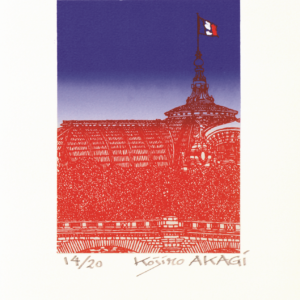
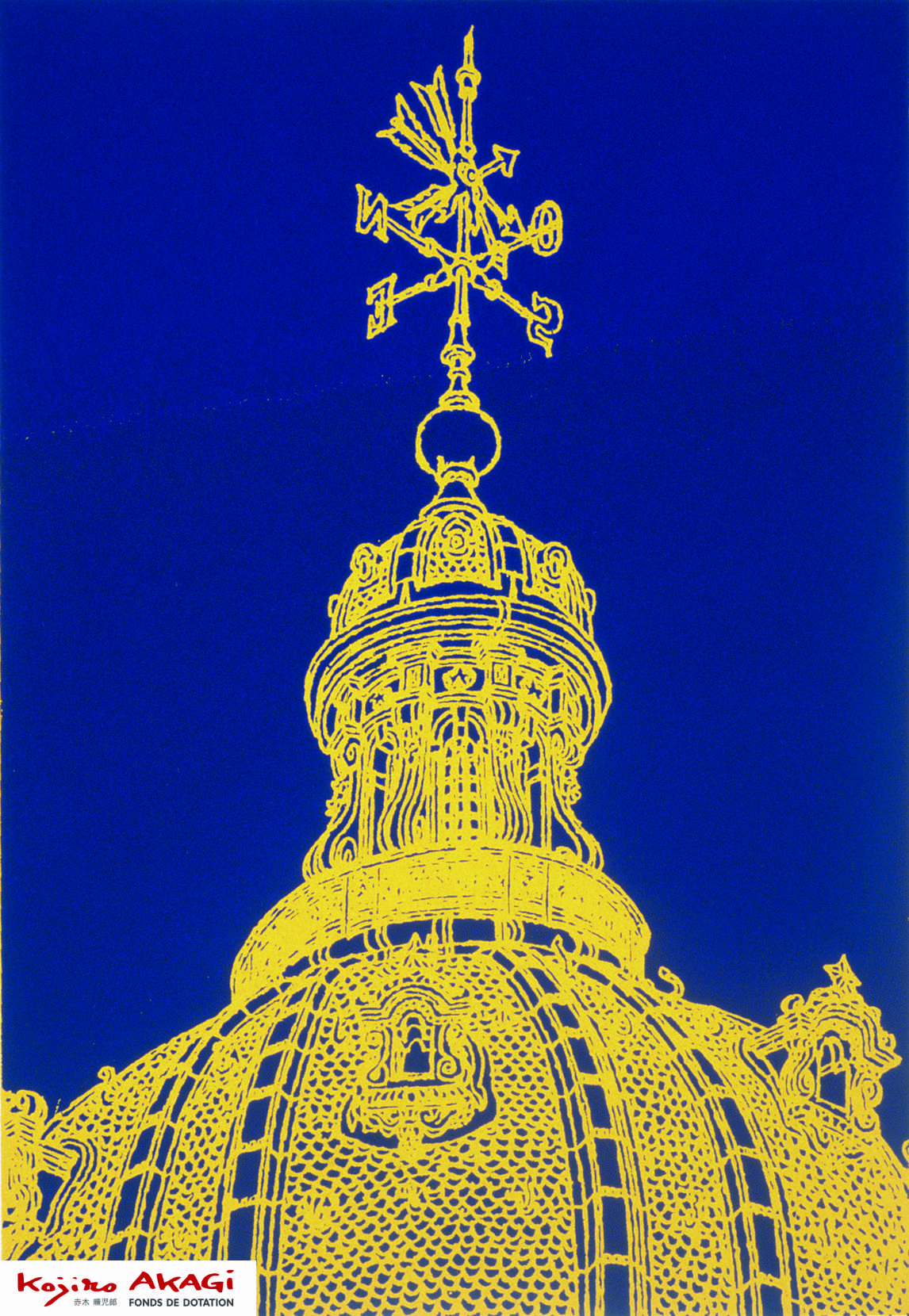
Titre : La coupole de l’Institut de France / The Dome of the Institut de France / 学士院のドーム
Créateur : Kojiro Akagi (1934-2021)
Date : 1996
Format : Sérigraphie, Atelier Del Arco,
50 tirages + 20 E.A. romain + 5 E.A. sans numéro,
sur papier Arches 15 x 24,5 cm.
Type : Sérigraphie
Collection : Cent vues de Paris / 100 views of Paris in lithography / アカギの版画パリ百景
Droits : © Fonds de dotation Kojiro AKAGI, © ADAGP
La coupole de l’Institut de France
Ce bâtiment, qui abrite l’Académie française, est célèbre pour sa coupole devenue symbole de l’Académie française. Cette école a été léguée en héritage par le cardinal Mazarin, premier ministre de Louis XIV. Construite entre 1663 et 1668 (époque du 4e shogunat de TOKUGAWA nommé Ietsuna), elle deviendra une chapelle où est installé le cercueil de Mazarin.
Le bâtiment a été conçu par l’architecte Le Vau, auteur d’autres édifices de l’époque tels que les Châteaux de Versailles et de Vaux-Le-Vicomte.
Lorsqu’on observe la coupole de l’intérieur, le plafond n’est pas rond, mais ovale. Si un artiste la dessine, on peut savoir s’il a triché en utilisant une photo comme modèle, car il lui donnera une forme ronde due à un effet d’optique. Je reste émerveillé par cet habillage architectural
calculé pour que tout paraisse régulier et en même temps majestueux vu du Louvre. En 1805, sous l’ordre de Napoléon, l’Institut de France déménage du Louvre pour venir s’installer dans ce bâtiment qui était à l’époque une ancienne école.
La Coupole de l’institut de France
L’Institut de France is famous for its cupola (domed ceiling) and it is so wellknown that if you say La Coupole it is taken to mean the Académie Française (housed in the Institut de France). There is a restaurant of the same name in Montparnasse. It was a school built from 1663-8, around the time of the 4th shogun Ietsuna Tokugawa, with funds bequeathed by Cardinal Mazarin, Prime Min-
ister under Louis XIV. In the middle was a chapel built to enshrine the remains
of the Cardinal and the coffin of the founder was entombed under the dome. The
architect was Le Vau, responsible for a variety of buildings at that time, including the Château de Versailles and the Château de Vaux-le-Vicomte. From the inside you can clearly see that the dome is not circular but oval, the long axis running from side to side. When I see it from the side of the Louvre Palace I am impressed by the fact that it was designed to look massive and noble, but if I were to draw it as a simple dome inspired by pictures or other sources, people would soon realise I hadn’t seen it with my own eyes. After having been a school, l’Institut de France was transferred here from the Louvre Palace in 1805 under the command of Napoléon.
学士院のドーム
アカデミー・フランセーズの入っている、学士院の会館の建物は、クーポール
(丸天井)のドームが有名で、冠詞をつけてラ・クーポールと言うと(同名のレス
トランもモンパルナッスにあるが)アカデミー・フランセーズ、学士院のことを指
すくらい、この丸天井は知られている。ルイ十四世の宰相だったマザラン枢機卿
の遺産で、一六六三年から六八年(徳川四代目将軍家綱の頃)にかけて建てら
れた学校だった。その真ん中にマザラン枢機卿の遺体を安置するために作った
チャペルで、丸天井の真下に創設者のお棺が安置されていた。建築家はベルサ
イユ宮殿とか、ル・ボー・ル・ビコントの城など、当時のいろいろな建物をつくっ
たル・ボー。ただし中に入って内側から見ると、この丸天井は円形ではなくて、楕
円形に横長なのである。ルーブル宮殿がわから見るとドッシリと端正に見えるよ
うに計算され、設計工事されているのに感心させられるが、簡単にドームだから
と、写真などから判断して、円形のつもりで描いたらすぐバレる。学校だった後
に、学士院がルーブル宮殿から移転して入ったのは一八〇五年で、ナポレオン
皇帝の命令でここに引っ越したのである。